
In a small company a board meeting often means a quick two-person video call, or one director deciding alone to pay a dividend.
Either way, the board has made a decision, and it needs minutes.
Board minutes are a written record of what the board decided and why. They can be short, as long as they’re accurate, signed and easy to find again.
By law, every company has to keep minutes of its directors’ meetings for at least 10 years from the meeting date. Skipping them is an offence, and the directors responsible can be fined. Paper and digital both work.
If you and your co-director both reply “agreed” to an email about a new supplier, you’ve made a board decision, and it goes in the records too.
Board minutes for a small company fit on one page, in six parts. You can reuse it for every meeting and only change the decisions and actions.
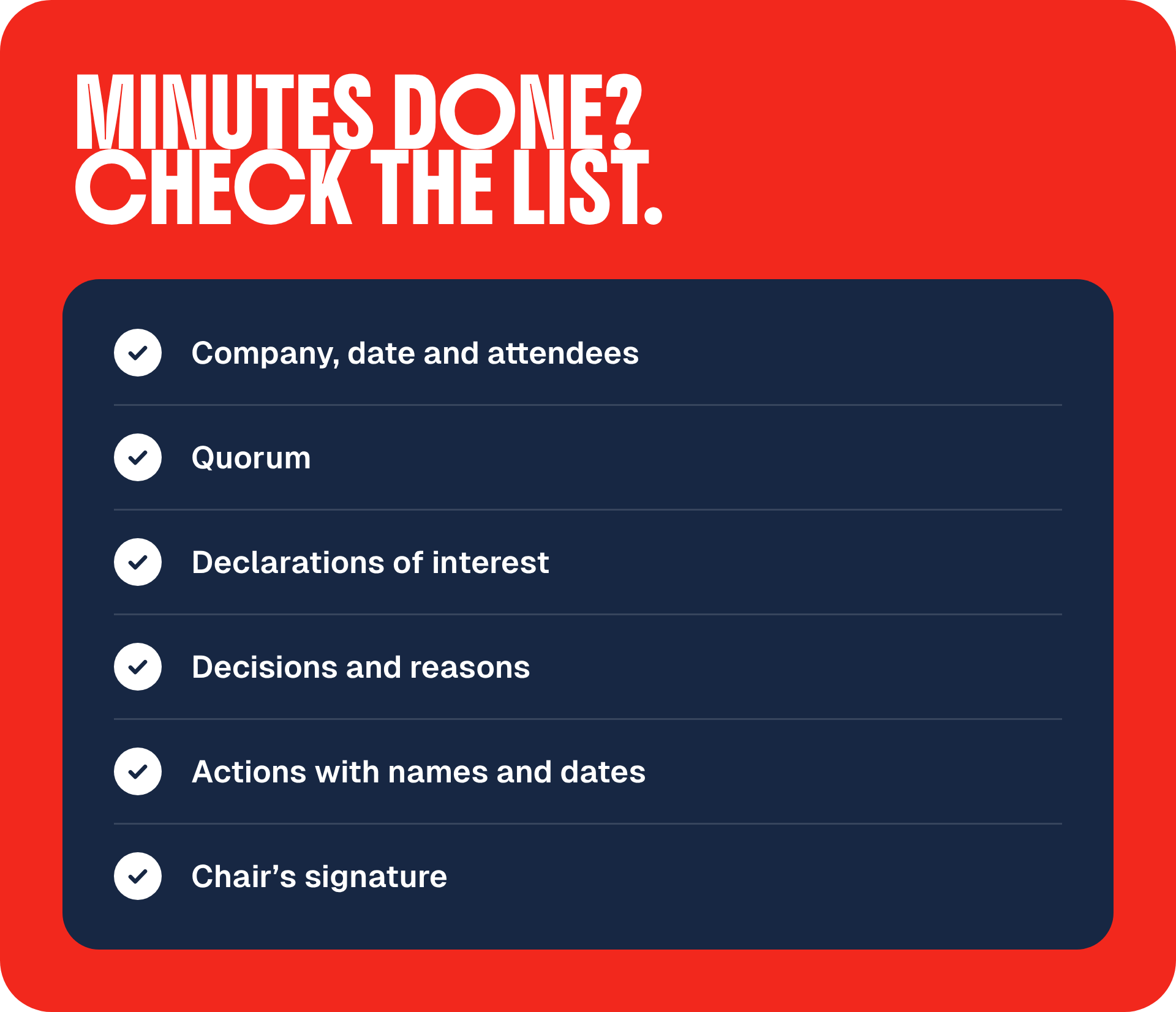
The basics are the company’s name and number, the date, where the meeting happened (a video call counts), who attended and who didn’t.
Below that, note that the meeting had a quorum, meaning enough directors took part for the board to make decisions. Under the model articles (the default company rules), that’s at least two, so in a two-director company you both need to be there.
Then write down any declarations of interest. If an item involves one of you personally, like a contract with another company you own, the minutes say so, and that director usually doesn’t vote on that item.
Most of the page is the decisions. For each one, write what you decided and the main reason in a sentence or two, like hiring a freelance designer to finish the website before launch. A director who joins next year should be able to follow it without calling you.
Add any actions with a name and a date, and finish with the chair’s signature.
If you’re the only director, you can decide alone, so your meeting minutes just skip the quorum and declarations of interest. List yourself as present and as chair, and sign them yourself.
When it’s a dividend
If you only ever write one kind of minute, it’ll probably be for a dividend.
GOV.UK says you need a directors’ meeting to declare it and minutes of that meeting, even if you’re the only director. The order matters here:
- Check the company has enough profit
- Hold the meeting and write the minute
- Prepare a dividend voucher for each payment, showing the date, company name, shareholders’ names and amount, and give each shareholder a copy
- Pay the dividend
Money taken out before the dividend is declared can end up as a director’s loan, which comes with its own tax rules.
Once the dividend is paid, it’s your money. An Ampere private account gives you your own balance and card for salary, dividends and everyday spending, so personal money stays out of the company account. It’s a separate application for eligible directors and owners of companies with an active Ampere business account. Open a private account
After the meeting
Write the minutes up within a few days, while everyone still remembers the meeting the same way. Send the draft to the other directors, fix anything they spot, and have the chair sign the final version.
Plenty of boards sign the last meeting’s minutes at the start of the next one.
Signing also protects you. Signed minutes count as legal evidence of what happened, so if a co-founder ever remembers a decision differently, the signed copy backs up what you agreed.
Then file it: one folder, one file per meeting, named by date.
If you ever sell the company, the buyer will want to see its records, minutes included, and a tidy folder makes that a quick job.