
When you price a product, the percentage you add to the cost (your markup) and the share of the price you keep (your margin) are two different numbers.
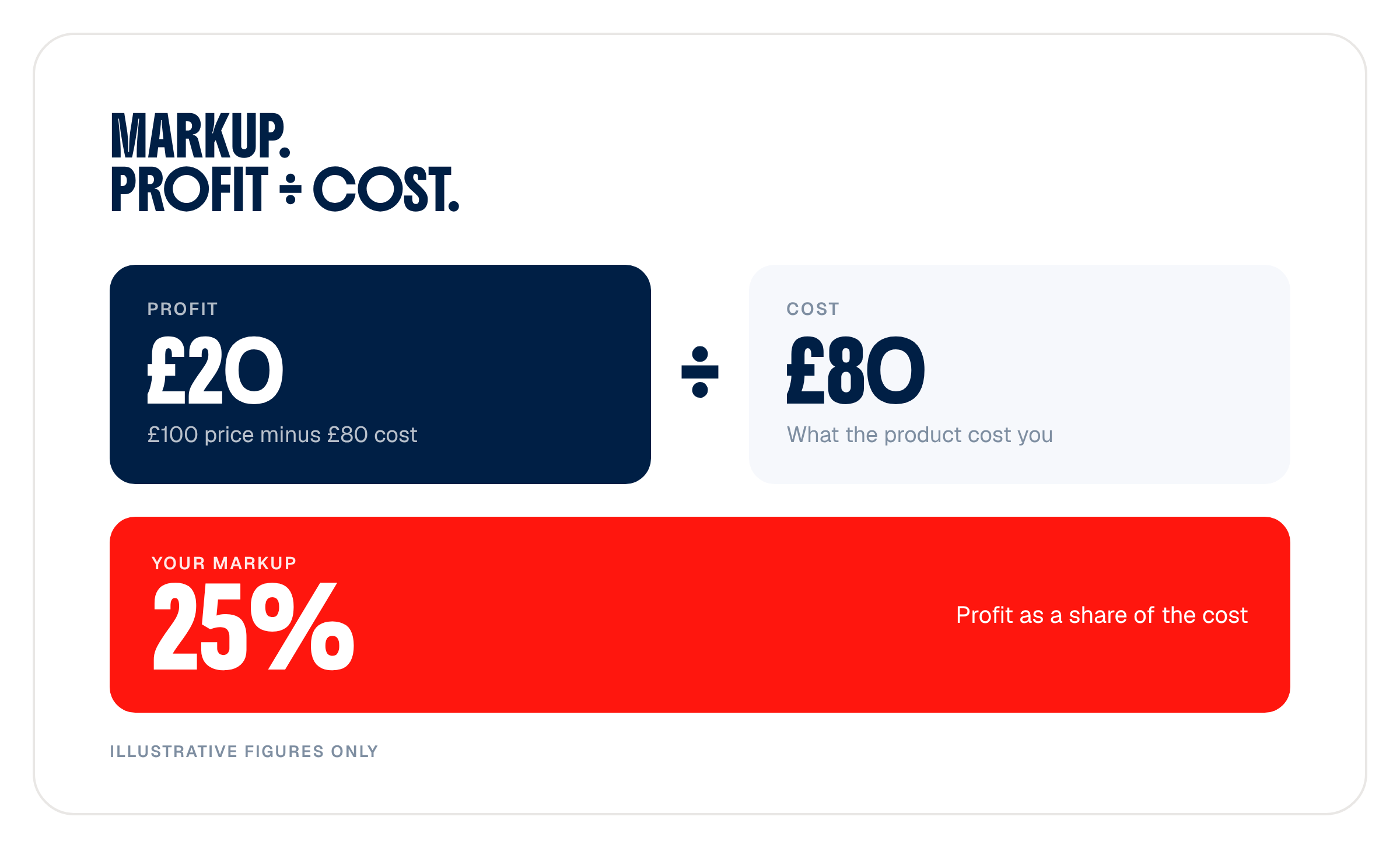
A product that costs you £80 and sells for £100 has a 25% markup but only a 20% margin, so mixing them up can leave you charging less than you meant to.
The markup formula divides your profit by what the product cost you:
Markup = (selling price minus cost) ÷ cost × 100
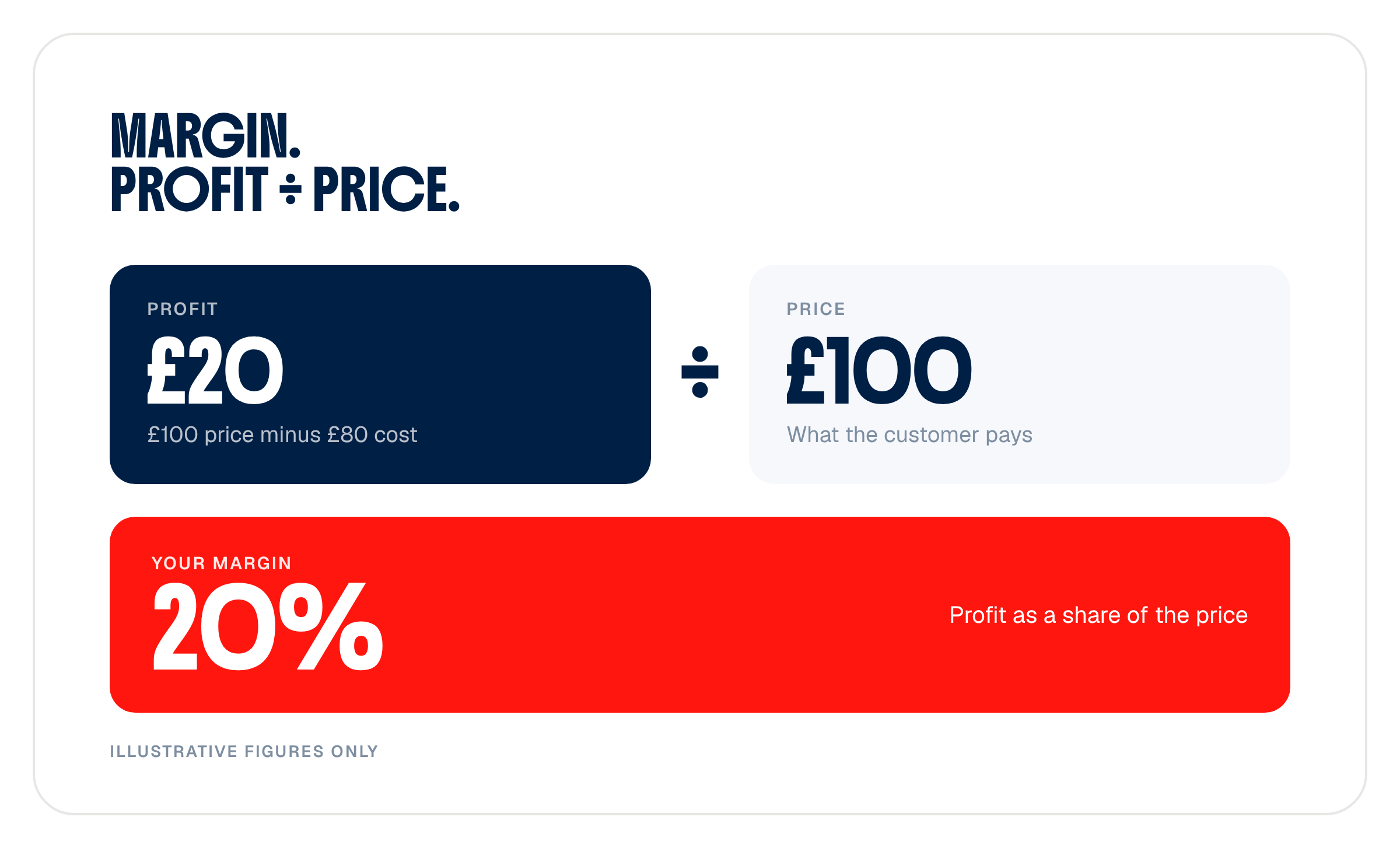
Learning how to calculate profit margin is just as quick. Divide that £20 profit by the price:
Profit margin = (selling price minus cost) ÷ selling price × 100
On a profitable sale, margin always comes out lower than markup, because the selling price is the bigger number.
Markup has no ceiling, and a 100% markup just means you charge double what the product cost you. Margin stays under 100%, since part of every price goes to covering the cost.
A few common pairs make switching between the two quicker:
- 25% markup gives a 20% margin
- 50% markup gives a 33.3% margin
- 100% markup gives a 50% margin
For any other percentage, write the markup as a decimal and divide it by 1 plus itself. A 40% markup becomes 0.4 ÷ 1.4, which is about a 28.6% margin.
Pricing for the margin you want
The usual mix-up with margin vs markup happens at pricing time. You want to keep 25% of every sale, so you add 25% to the £80 cost and charge £100. The margin on that price is 20%, and each sale earns a bit less than your plan.
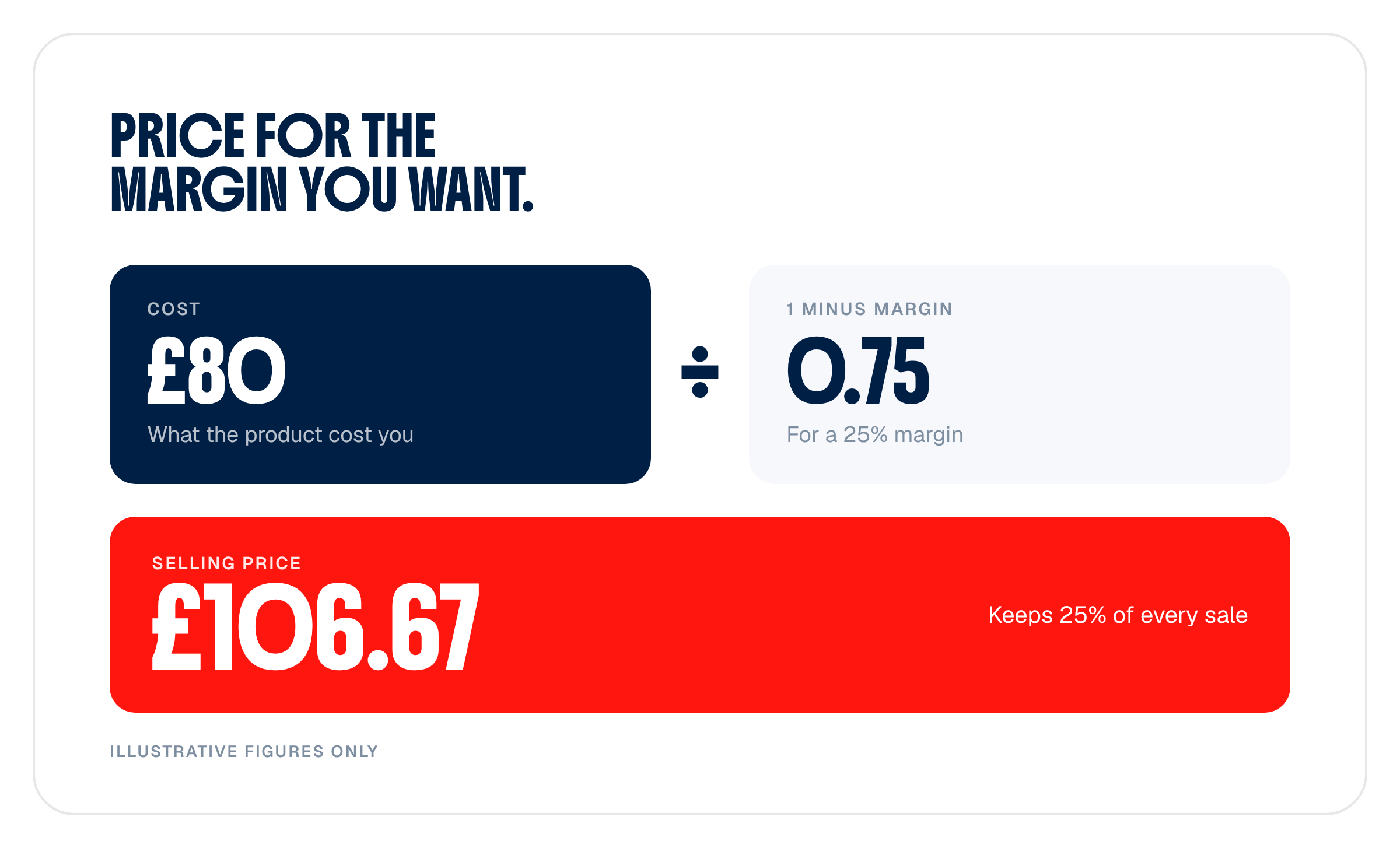
To hit a margin target, divide the cost by 1 minus the margin:
Selling price = cost ÷ (1 minus target margin)
Every formula above works best when the cost includes everything it takes to get the product to your customer.
For a product, the full cost usually covers the supplier’s price plus delivery, packaging and card payment fees. A service business might count a subcontractor’s fee or the materials for each job.
Buying stock from abroad adds another cost.
If your supplier invoices you in euros or dollars, the price in pounds depends on the exchange rate and the fee for converting, and both can change between orders. If you leave the conversion out, your real margin ends up lower than the one you calculated.
In an Ampere business account, you see the reference rate and Ampere’s fee before you confirm a currency exchange, so you know what your stock costs in pounds before you set a price. See how currency exchange works
Discounts come straight out of your margin, because they lower the price and leave the cost where it was.
Take 10% off the £100 product and you charge £90 for something that still costs you £80. Your profit drops from £20 to £10, so a discount that sounds small halves what you earn on each sale.
Before a promotion or a bulk deal, work out the margin on the new price first.
If your business is VAT-registered, use the price and the cost without VAT. The VAT you charge customers goes to HMRC, and you can usually reclaim the VAT you pay on business purchases.
Margin for your whole business
You can also work out a margin for a whole month or year.
Gross profit margin uses your total sales and your cost of sales, which is what the products or jobs themselves cost you:
Gross profit margin = (total sales minus cost of sales) ÷ total sales × 100
Net profit margin goes one step further. It takes off everything else the business pays, like rent, salaries and tax, and divides what’s left by total sales. A business can have a healthy gross margin and a thin net one if its running costs are high.
The share you keep from each sale also feeds into your break-even point, so a better margin means fewer sales to cover your monthly bills.
When you price something new, markup is quick to work with, because you start from what it cost you. If you have a margin in mind, the selling price formula above gets you there just as fast.
Once sales come in, margin shows how much of each pound you keep, and you can compare products and months with it directly.
Whichever you use, label it. A “25%” in a spreadsheet can mean either one, and the difference will show up in your profit.